

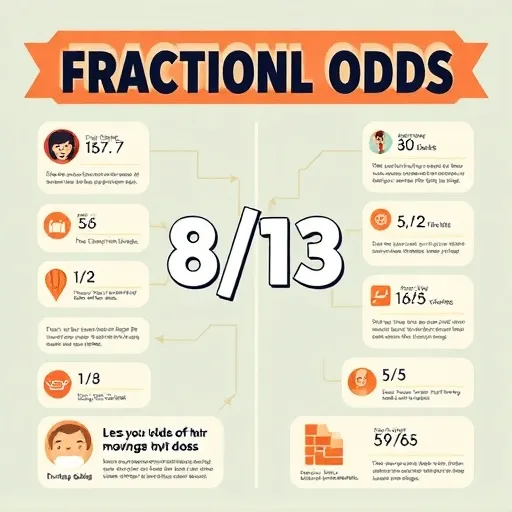
Fractional odds expl
What Are Fractional Odds, Really?
Fractional odds are basically a shorthand way of showing the relationship between what you put down and what you'd pocket in profit if your bet hits. You'll see them written as two numbers with a slash between them — like 8/13, 5/2, or 1/3. And honestly, once you get the hang of betting odds explained 8/13, the whole fractional system suddenly clicks into place.
The number on the left (the numerator) tells you the profit you'll make relative to the number on the right (the denominator), which represents your stake. So with 8/13, here's the breakdown:
- 8 = the profit you earn
- 13 = the amount you need to stake
Put another way, for every 13 units you wager, you'd collect 8 units in profit if your selection comes through. Add your stake back into the mix, and your total return would be 21 units. That's the core of betting odds explained 8/13 — it's a profit-to-stake ratio, not the total payout.
A Quick Real-World Example Using Fractional Odds and Stake Calculations
Let's make this concrete. Say you place a $13 bet at odds of 8/13. If your pick wins:
- Your profit = $8
- Your total return = $13 (stake) + $8 (profit) = $21
Pretty straightforward, right? This is exactly why betting odds explained 8/13 matters so much for newcomers — the fraction tells you the profit-to-stake ratio, not the total return. That's the key distinction that trips up a ton of people when they first start looking at fractional odds.
Why 8/13 Falls Into the "Short Odds" and "Odds-On" Category
In the world of betting odds explained 8/13, this price lands firmly in the "short" or "odds-on" territory. Notice that the numerator (8) is smaller than the denominator (13). When the first number is smaller than the second, the implied probability is greater than 50%. That means the oddsmaker considers the outcome more likely than not.
Let's translate 8/13 into implied probability. The formula is:
Implied Probability = Denominator ÷ (Numerator + Denominator)
So: 13 ÷ (8 + 13) = 13 ÷ 21 ≈ 61.9%
That means the bookmaker is effectively saying there's about a 61.9% chance of that outcome happening. That's a fairly strong favorite. Not a slam dunk, but clearly the more probable side of the equation — and this is a perfect illustration of betting odds explained 8/13 in action.
Comparing 8/13 Against Other Common Fractional Odds Prices
To put 8/13 in context, here's how it stacks up against other familiar fractional prices:
- 1/2 ≈ 66.7% implied probability (heavier favorite)
- 8/13 ≈ 61.9% implied probability (strong favorite)
- Evens (1/1) = 50% implied probability (coin flip)
- 6/4 = 40% implied probability (underdog)
- 5/1 ≈ 16.7% implied probability (longshot)
Seeing 8/13 tells you immediately that you're looking at a selection the market respects but doesn't consider a near-certainty. This comparison is a great example of betting odds explained 8/13 alongside other fractional odds formats.
Converting 8/13 into Decimal Odds and American Moneyline Formats
Not every betting platform uses fractional odds. Depending on where you're betting and where you're located, you might see decimal odds or American moneyline odds instead. Here's how 8/13 translates across formats — another crucial piece of betting odds explained 8/13.
Decimal Odds Conversion and Total Return Calculations
Decimal odds represent your total return per unit staked. The formula is:
Decimal Odds = (Numerator ÷ Denominator) + 1
So: (8 ÷ 13) + 1 ≈ 0.615 + 1 = 1.62
A decimal price of 1.62 means every $1 you stake returns $1.62 if you win (including your stake). This is where betting odds explained 8/13 becomes really practical — you can see the same probability expressed in a completely different format.
American Moneyline Odds and Negative Price Interpretation
Because 8/13 is an odds-on price (implied probability above 50%), it converts to a negative moneyline. The formula is:
Moneyline = -(Denominator ÷ Numerator × 100)
So: -(13 ÷ 8 × 100) = -162.5, typically rounded to -163 or -162 depending on the platform.
That means you'd need to wager $163 to win $100 in profit. Understanding this conversion is essential for betting odds explained 8/13, especially if you're switching between betting platforms that use different odds formats.
The Implied Probability Trap and the Bookmaker's Margin Explained
Here's where things get interesting — and where a lot of bettors leave money on the table. The implied probability we calculated (61.9%) includes the bookmaker's margin, often called the vig or overround. That margin is baked into every price you see.
If you add up the implied probabilities of all possible outcomes in a market, they'll typically exceed 100%. That excess is the bookmaker's built-in edge. So the "true" probability of an 8/13 selection might be slightly lower than 61.9% once you strip out the margin. This is a critical concept in betting odds explained 8/13 that most beginners overlook.
This is why understanding value betting matters. A price of 8/13 isn't automatically a good or bad bet. It's only good if you believe the actual probability of that outcome is higher than what the odds imply. If you think the real chance is 65%, then 8/13 offers value. If you think it's 55%, it doesn't. That's the heart of betting odds explained 8/13 — it's not just about reading numbers, it's about interpreting them.
How to Spot Value at Short Odds and Minimize Margin Impact
Short odds like 8/13 leave less room for error. Your profit margin is thinner, so accuracy in your assessment matters more. Here are a few practical tips:
- Do your own research. Don't just accept the market's view. Look at recent form, head-to-head records, and any relevant context like injuries or scheduling.
- Compare prices across platforms. The difference between 8/13 and 4/6 might seem tiny, but over hundreds of bets it adds up — and this is where betting odds explained 8/13 really pays off.
- Consider the draw or tie possibility. In many sports, especially those with three-way markets, short odds on one side don't account for the possibility of a stalemate.
- Think in terms of expected value. A string of short-odds winners can build your bankroll steadily, but one upset can wipe out several wins. Size your stakes accordingly.
Fractional Odds in the Modern Betting Landscape and Data-Driven Markets
The betting world in 2026 is more data-driven than ever. Advanced analytics, machine learning models, and real-time data feeds have changed how odds are set and how bettors approach their selections. But the fundamental language of odds, including fractional odds, remains the same because it's intuitive and time-tested. Betting odds explained 8/13 is still as relevant as ever.
Many established betting platforms still default to fractional odds in certain regions, particularly in the UK and Ireland. Others offer decimal as their primary format. The best approach is to learn all three formats so you're never confused, no matter where you're looking — and betting odds explained 8/13 gives you a perfect starting point.
The Rise of In-Play Betting and Micro-Betting Markets
One trend that's accelerated in recent years is in-play betting, where odds shift in real time as events unfold. In this environment, understanding short prices like 8/13 becomes even more critical because you're often evaluating rapidly changing probabilities. A team that was 8/13 before kickoff might drift to 2/1 after conceding an early goal, and knowing how to interpret those shifts quickly is a genuine skill. Betting odds explained 8/13 prepares you for exactly these moments.
Similarly, micro-betting markets (betting on individual plays, next point, next possession, and so on) often feature short odds. Being fluent in fractional notation helps you make split-second decisions without fumbling for a conversion chart. That fluency in betting odds explained 8/13 is a real edge in fast-moving markets.
Common Mistakes Bettors Make with Short Odds and Fractional Prices
Even experienced bettors can fall into traps when dealing with short odds. Here are a few pitfalls to watch for:
1. Assuming Short Odds Mean "Safe" and Guaranteed Returns
An implied probability of 61.9% means there's still a roughly 38% chance the bet loses. That's more than one in three. Short odds are not guarantees. Treating them as such leads to overstaking and, eventually, painful losses. Betting odds explained 8/13 should always remind you that 61.9% is not 100%.
2. Ignoring the Accumulator Effect and Parlay Probability
Many bettors combine several short-priced selections into an accumulator (parlay). While this can boost the overall payout, it also multiplies the probability of failure. Four selections at 8/13 each gives you a combined implied probability of roughly 14.6% (0.619 × 0.619 × 0.619 × 0.619). That's a long way from a sure thing — a key lesson in betting odds explained 8/13.
3. Chasing Losses with Short Odds and Poor Bankroll Management
A common behavioral trap is increasing your stake on short-odds selections to recover previous losses. This is a fast track to significant damage. Responsible bankroll management is always more important than chasing a quick recovery. Betting odds explained 8/13 isn't just about math — it's about discipline too.
4. Not Shopping Around for the Best Fractional Odds Prices
Prices vary between betting platforms, sometimes significantly. A selection at 8/13 on one site might be 4/7 or even 8/15 elsewhere. Over time, those small differences matter. Always compare before you commit — betting odds explained 8/13 is as much about shopping smart as it is about reading numbers.